It will be all right if you come again, only next time
|
1994 / 2025, 5-channel installation |
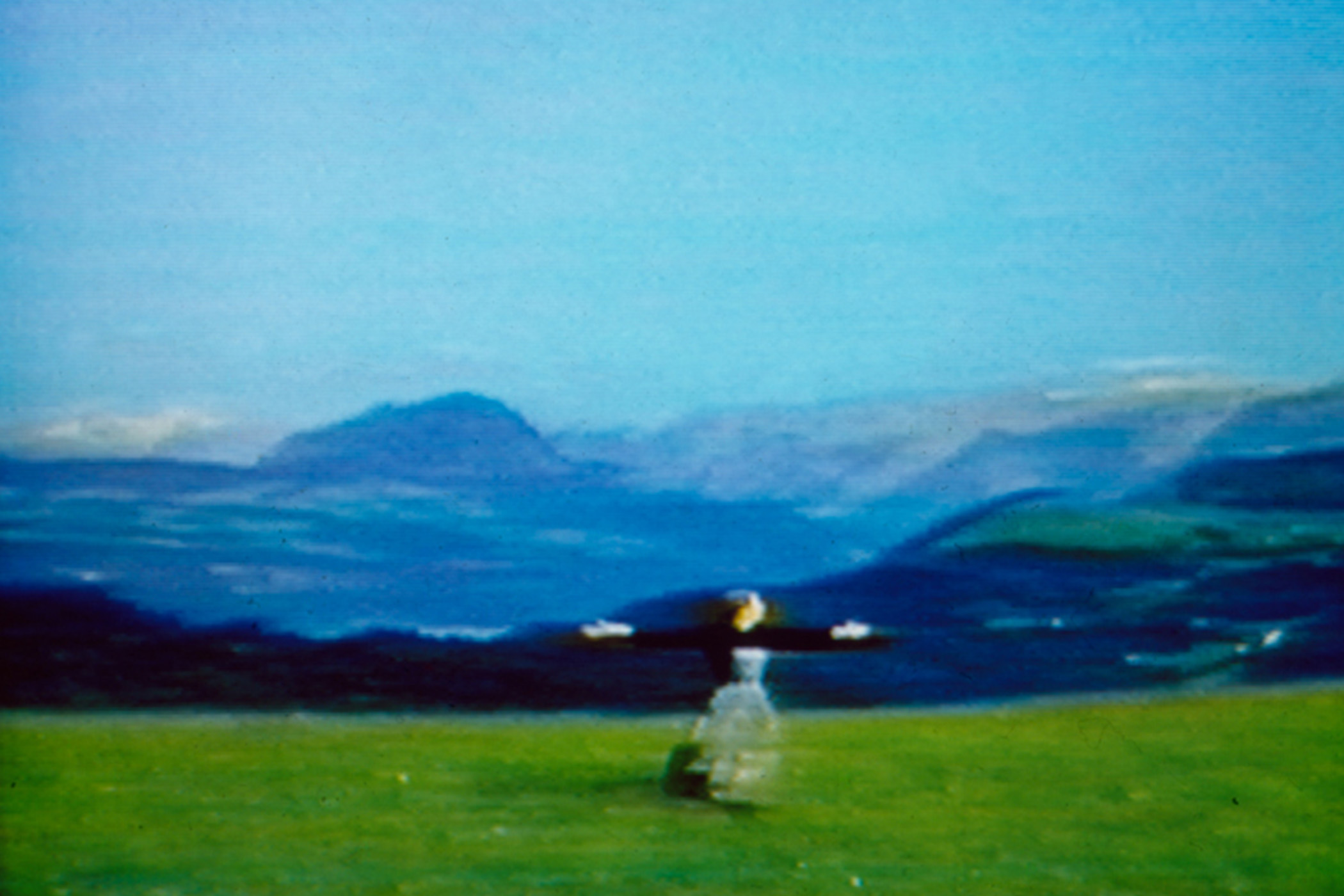
Onome Ekeh: Prepackaged |
—Well, ‘The Sound of Music’...
‘The Sound of Music (1965): Starring: Julie Andrews & Christoffer Plummer. Co-starring: Richard Haydn. Eleanor Parker as the baroness. Music by Richard Rodgers. Lyrics: Oscar Hammerstein II. Screenplay: Ernest Lehman. Based on Rodgers & Hammerstein’s Broadwayplay The Sound of Music; inspired on the biography of Maria von Trapp. Directed by Robert Wise.
I’ve seen it about more than 300 times, over a period of 10 to 12 years. I saw it almost every other day. At least I wanted to sing like Julie Andrews; the first times I watched it I was humming ‘My Favourite Things’ all week...
—Can you still recall the impressions you had seeing the film for the very first time?
1977. We just had moved to the university-campus in Ibadan (the largest city in Nigeria). There was a staff club where they had these family movies every friday night and it was the first thing I watched there... it was across a pool, there were barbecues and everything. It was one of the most incredible things I had ever seen.
—You had seen films before?
Yes, but this one was on an enormous screen, like one of those IMAX screens. You could see the reflection of the pool; sometimes I had the habit of watching the reflection in the pool. I’d squint my eyes, so I would see a double image of that palace in the water. I nearly drowned once in that pool! Chlorine...
—What about the 300 other times you watched it?
Then the VCR revolution hit Nigeria; ‘78/’79 we got our first videomachine. In Nigeria: the very first movie you saw on the VCR was either The King and I or The Sound of Music. Most of the time The Sound of Music, because it was given for free with the electronic equipment as part of the video cassette recorder package. It was The Number 1 movie, all that singing plus all that nice Austrian plushness; very appealing... You could see it everwhere you went. And if you didn’t have the film, somebody would definitely give a copied version to you. People would have these big borrowing systems—my cousin had an enormous beehive collection of videos: over 500 titles. They would borrow from you and never return the tape and at the end you had to borrow from them.
Picture this: summer vacation, and there are enough cousins staying over to form a football team, they’re playing soccer all morning, come back in about noon—video time. They’re watching Fist of Fury or some other Kung Fu stuff that our parents didn’t approve of. The living room is a big mess and 13 sweaty boys are egging on Bruce Lee, suddenly we hear my mother’s car pull into the driveway! The living room is somehow thrown back into place, the boys adopt civilised postures, and the Sound of Music is slipped in. My mom comes in about to make a fuss about the mess, but instead she’s distracted by ‘Edelweiss’ and ends up watching the whole thing, again, with everybody. We never got tired of it; they probably still love it. You know it’s like part of the landscape of my past, my childhood.
I saw an incredible amount of movies growing up in Nigeria, thanks to video-piracy! Hollywood epics, obscure European stuff recorded off TV, Indian movies, Kung Fu flicks... Copyright laws ceased immediately they were on Nigerian soil. At “Video Rentals” you wouldn’t rent, what you actually did was take in blank tapes to make recordings from the master.
Once I went to my mother’s family, one of the many times we were watching it—they were complaining about Julie Andrew’s ugly clothes, her brand of blandness, her bad haircut... I was devastated...I was like...saying no no no, she’s supposed to be the heroine. The Cinderella. But they just loved the baroness Schreider or Schneider, Schraeder?
—Why would they be particularly attracted to the baroness instead of the Julie Andrews character; was there any culture-specific reading to it in terms of family life in Nigeria?
She was rich, she was beautiful, independent, sensual, sophisticated, she realized what she wanted. They totally approved the way she went after the captain! And they understood the fact that she would have to send the children away to the boarding school, because in Nigeria you don’t want other people messing up your own share of things. It’s this big extended family thing in Nigeria, it has its plus side, but generally there’s a lot of pettiness and jealousy going on. No one wants some upstart coming into their homes, some nun or some housegirl like Julie Andrews coming in, taking their man. They completely identified with this baroness.
As I grew older I started to identify with her too, but rather with the schemey-ness of the baroness, she was like a pre-Joan Collins in Dynasty, whom I really loved.
Julie Andrews was tricked by family values: the American dream. The captain and the seven children—a perfect pre-packaged family. Doesn’t it sound like the Immaculate Conception? She abandons all those females and she achieves a rite of passage from girlhood to womanhood—virginity intact. It’s quite clearly implied by now that she never has sex with the Captain… too air-brushed; though, for some, she impersonates the ulitmate dyke…
That whole Sound of Music is like a big Coming-Out story for everybody in that movie. Julie comes out of a convent, a whole single-sex system, the captain is coming out of this all male military thing. The kids are pretty much cloistered. Next they’re going out into the Alps towards Switzerland (Italy), because Austria has been invaded by the Nazi’s...
—After having seen the film so many times, what would you remember as your favourite scene?
The scene with the pink lemonade always fascinated me, with Baroness von Schraeder and the guy Max, I always loved him, he was a kind of smarmy Clark Gable type of man… and there is Christopher Plummer… you know he hated the movie! He never approved of it…
The pink lemonade! I always thought there was something hidden in the meaning of the lemonade. The too-pinkness of it, the tartness. The sharp and the sweet.
— How did you relate to the landscape presented in the film, did it look familiar to your everyday environment?
Well, we travelled a lot. That whole landscape became part of my childhood imagination— kind of grew up with that fantasy landscape.
— You didn’t relate to the film with a sense of your difference towards an all white cast in ‘The Sound the Music’?
Not really, at that time I probably thought I was still white. I was a kid with an American accent, so people in Nigeria always asked me if my mother was (Black) American. I think it had to do with being transplanted from one culture to the other. I was born in the U.S., and went back to Nigeria at the age of seven. So a lot of my mind was pretty much gelled by then, my impressions of the world. I was an American kid who was slowly Nigerianized. In fact I didn’t really realize that I was black till I was about 9 years old, when the whole South African thing blew (Apartheid).
This had to do with TV. I used to have all these fantasies, even within my dreams I found out that my persona was a white character in my dreams. That I had red hair and green eyes, kind of like Julie Andrews.
As I got older I was constantly reminded of the depth of my skin color… People in Nigeria would tell me I was too dark. During one occassion I had to get sponsors to raise money. With two of my friends I went to this guy who owned an airline company, Flash Airlines, and a football team called Flash United. He liked my friends because they were lighter skinned, but he was pointing at me—’You, you are too black—got out this bleaching cream of his desk (from all places Harrods in London) and he said I should use it with sandpaper. I was horrified, and I thought: ‘Keep your loot, moron…’ I got hasselled a lot because I was darker than most people. Most of the people of my generation having been acquainted with the likes of Janet Jackson; the hacked off ribs, the sawed down nasal cartilage, their ideal is more like…
— Julie Andrews?
No, more the baroness Von Schraeder, she’s more the glam poster girl… I’m sort of grateful for the whole alienation process of growing up. One fine day I found myself in Nigeria. I thougt it was a vacation and I asked my mother when we were going back home: she said We are home. Uprooted. Displaced. Besides I had been promised we’d go back to Disneyland for my birthday. My birthday came and went. I was still in Nigeria and we didn’t go to Disneyland. For years I could never wholly assimilate into the cultural landscape of Nigeria. I realised I wasn’t fully Nigerian. I wasn’t really Nigerian so I must be American. I get here and discover I’m not American either. I thought: ‘No, Disneyland is not for me, really heartbreaking! Most importantly I realised I didn’t have to be one or the other…
—What about the Nigerian broadcast system; were there any important Nigerian filmmakers at that time? There are quite a number of prestigious ones; they were kind of syncretic, meshed together. You had Nigerian sitcoms, which were immensely popular—more so than American ones. The British productions were not half as popular as American ones which were so much more glamourous. No one was really into the British working class thing…. They would identify with Hollywood glitter, the gloss, the plush, ecetera…
—Making a film yourself now, wouldn’t remnants of ‘The Sound of Music’ slip into the whole thing? In a sense. The whole thrust of my work now is iconoclastic, at least concerning the standards I was raised with. There was a shift in my overall sensibility towards the constructed narratives of my childhood; no longer did I identify with the princess in Sleeping Beauty, but rather Carabosse—the “bad fairy”, excluded from the ceremony because she perpetually wore black. In Snow White, my empathies were with the Wicked Witch Queen, who (at least in the Disney version) was reminiscent of Grace Jones…
I guess with The Sound of Music the sort of connections I’d make now in my work would be the inverse, Maria = Joan of Arc and Herr Capitan = Giles de Rais, who goes down in legend as The Lord Blue Beard…
—Did you ever rent ‘The Sound of Music’ again once back here in the U.S.?
Never. I did once see fragments of it again when a friend bought it for her daughter—the first time since years. I didn’t want to watch it. It’s frightening: I had watched it too many times. How in the world did I relate! It’s like a foreign country now.
Onome Ekeh is a writer and filmmaker living in New York City