It will be all right if you come again, only next time
|
1994 / 2025, 5-channel installation |
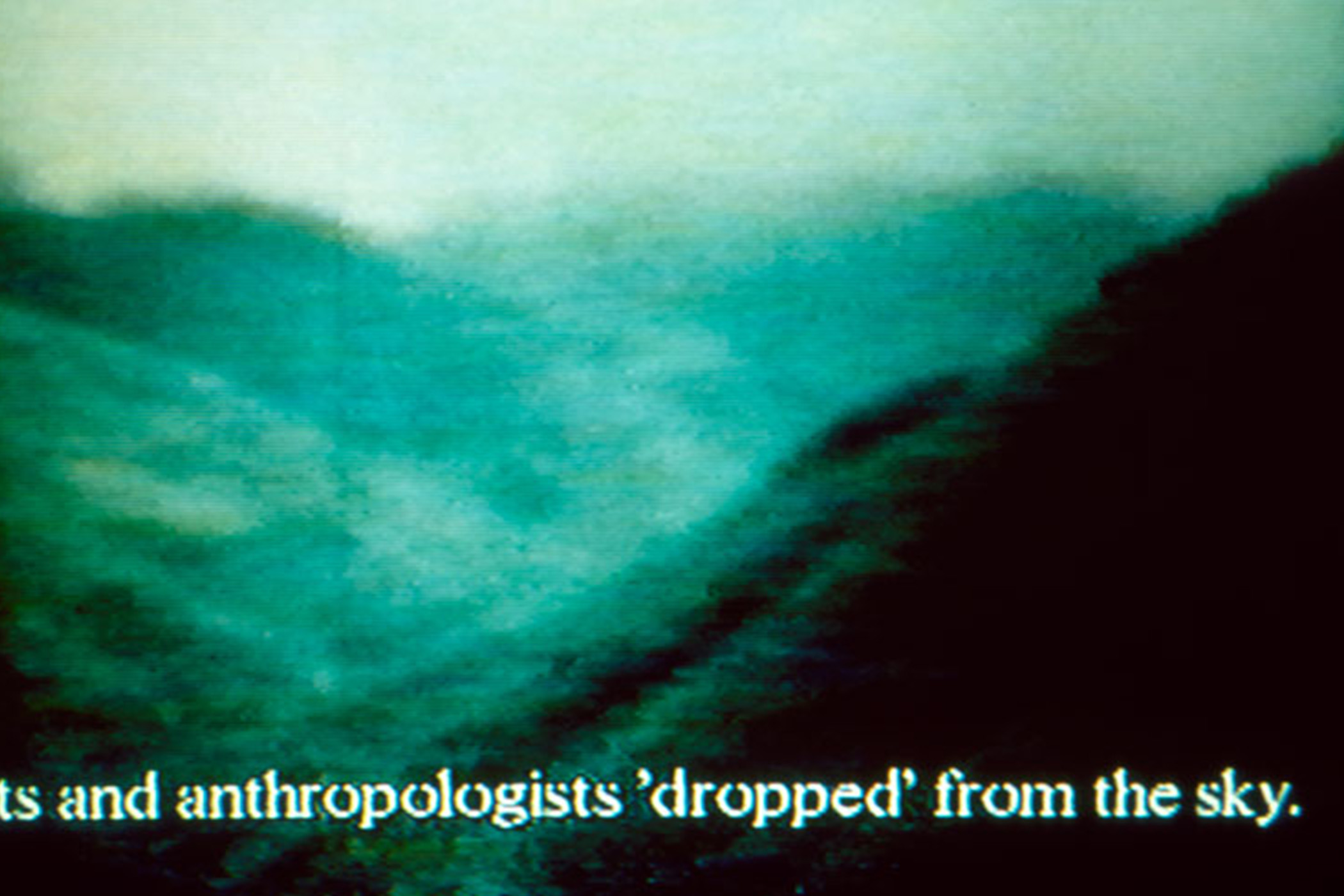
Todd Ayoung: A Mimetic Passage |
—Your first encounter with film was ‘The Sound of Music’; would you remember anything about the circumstances, how it must have been watching a movie for the first time?
‘The Sound of Music’ (1965): Starring: Julie Andrews & Christoffer Plummer. Co-starring: Richard Haydn. Eleanor Parker as the baroness. Music by Richard Rodgers. Lyrics: Oscar Hammerstein II. Screenplay: Ernest Lehman. Based on Rodgers & Hammerstein’s Broadwayplay The Sound of Music; inspired on the biography of Maria von Trapp. Directed by Robert Wise.
The recollections about it got so blurry and vague. I saw The Sound of Music when I was about seven years old, in Port-of-Spain (Trinidad) where there was only one big movie-theatre at that time. Films weren’t that well distributed, so if a film came around they would keep it as long as possible. I saw it one week and then the next week again... about 7 times. Being brought up in an Asian family, my parents were very protective; if we weren’t going to school we (me and my sisters) would be locked up in our little house. It was summer I believe and there was not a whole lot to do, so my uncle would sometimes take us to the movies...
Now, here there is a strange thing—it’s hard to figure out in what way this is due to being part of a colonial situation, or more in terms of this being a part of the child’s imagination—but I always thought that cinema was something real and that there were people behind the screen.
This is how I came to explain it: one of the movies that showed there was The Planet of the Apes and I remember vividly seeing a cage with a bunch of apes driving around Port-of-Spain, because that was the way they advertised it. So I thought: of course, those apes just go behind the screen playing apes and this now ends up on a flat surface, with other kinds of projections going on, but they were real people.
—‘The Sound of Music’ was perceived in the same way?
I didn’t think about it in terms of any real filming or what it meant besides a visual spectacle.
—There was no television yet? Any imagery that could relate to cinema?
No, no television. TV came about in the late 60’s, somewhere before we came over to the U.S. in ‘69. We were one of the first families in this area of Port-of-Spain to acquire a TV; I even remember vividly all the neighbours sitting around our doorway watching this image making machine in black and white.
—The landscapes or the architecture presented in the ‘The Sound of Music’ must have been very different compared to your everyday environment?
The setting and architecture in the film was nothing like the Trinidad that I know, the old colonial buildings, the savannahs—there’s nothing like palmtrees in that film or anything that I could relate to. It was completely unreal... At the age of seven I didn’t think of it as such a big contrast between my little country and this image of the outside, but more this fascination with something else; it was just the ‘outside’, an imaginary place of people with a fantastic life, where everything seemed bigger, all that space compared to our little house.
Also I don’t think I ever saw so many white people together before in one place at the same time unless it was on screen; that may also have been a novelty for me at that moment. I might also have made some identification between The Sound of Music and what my father used to tell me about the U.S. and my uncle Sam. Uncle Sam was my uncle. Growing up in a Chinese family in Trinidad, anybody older than you became your uncle, and so my father always told us about this uncle which we never saw. I never thought I would acually meet this person.
—The Sound of Music came to stand for Uncle Sam, a collapse between the scenery in the film and the geographical place of the U.S. or England, where your uncle lived...
Well, my first confrontation with the ‘mothercountry’ England, being part of the Commonwealth, was effectively The Sound of Music. The film represented England for me, which was just this vast ‘outside’ where my Uncle Sam lived. I always thought of England as being an appendice to the U.S. in the sense that it was the mother of Uncle Sam. I never knew where these places were geographically. American culture was pretty basic in Trinidad, I didn’t really have any signs. I knew it was out there somewhere just as The Sound of Music was represented on screen as a physical ‘somewhere’. But I never thought of it as something graspable; I never thought I would actually go to these places.
While talking about our uncle Sam, my father would also show us a photograph of an immigrant boat coming into New York City, and there is an Asian looking man up in the front and my father would say: ‘Well, this is me, coming over on the boat’, but he never said where he came over from. He was born in Trinidad; where could he come from? It sort of predated our coming to the U.S. in 1969. He had to tell us these things, a way maybe to construct a relationship to his children. Only when I came to the U.S., I realized that this photograph he showed us was by Alfred Stieglitz (‘Streerage’, 1907). A strange kind of coincidence: I always thought of uncle Sam who I was going to meet and I always thought of my father coming to the U.S on this boat.
—‘Uncle Sam’ was actually conceived of as an Asian person...
A kind of collapse of images and personal history: in Trinidad you would have this mixing of real time, historical time and an imaginary situation compiled from mythology and superstition; which is perceived as very real to the West Indies, and structures everybody’s lives. Colonialism made Trinidad reinvent an imaginary landscape, constructed and hybrid through a degree of memory erasure. The Sound of Music conflated with these superstitious ways, just like other films shown there at this theater: Planet of the Apes, Chity Chity Bang Bang and what’s that other movie... My Fair Lady. In a sense it was a Disneyland-version of real history mixed in with all this strange stuff. I had a kind of ‘magical realism’ involved with daily life, populated with all sorts of spirits: jumbies, duppys... That was our cinema, the stories my father told us. It was told and retold so many times that it condensed into something magical. The same with film: retold, re-edited and passed through certain mediums so that it becomes magical. It makes sense then, with the invention of TV and film, that people identified so dearly with the images, that replaced or mixed with their mythologies, a way to explain life’s tragedies—why you were afraid of the dark, all these things.
Trinidad wasn’t wired up in the sense that you couldn’t just turn on the switch light, you had candles. I was brought up always being afraid of something that I couldn’t see, so you had a different relationship to space, it was very tight, beyond was always the dark that you couldn’t tangibly see.
—Eventually ‘The Sound of Music’ projected in the dark would have this magical quality to it as well, a different kind of mythology that would fit in with these stories...
When you see the dark you project your superstition whereas with cinema it would turn in the other way: the dark becomes a kind of projection; your superstition becomes this cinema, a screen for what’s lit up. Technology has taken over (intermixed) mythology and superstition in its most literal sense: the ghosts become shadows on the screen. Naturally I would transfer my stories into this medium which existed overseas, embodied in The Sound of Music especially. I think in my eventual ‘passage’, I came to identify with this ‘white light’ of the screen.
My name also comes from the movies: Michael Todd, the name of a famous British actor at that time (my whole name is actually Todd Michael Ayoung). My parents saw some old movie when they were first married; I was born when my mother was in her 20s, so instead of choosing a name of family history, they chose actor’s names for their kids. So I was inscribed into the history of cinema, making my construction of the self an imaginary construction in the literal sense.
—What about the narrative itself contained in ‘The Sound of Music’, how differently would you read into it then, at that time in Port-of-Spain, compared to the context of your life in New York now?
At that age it’s difficult to recall, I was just absorbing a lot of things. Eventually, the only way I could really relate to it was if I would think about it as some kind of passage to the real context of the U.S., eventually going to England, which was a disappointment for me; the imagination didn`t quite fit the reality I encountered:
I haven’t seen the film in its entirety since I’ve been in this country. It’s hard for me to look at that film; I’ve seen bits and pieces of it. Uncle Sam obviously became something else. At one point leaving Trinidad, coming to the U.S. at the age of eleven I found out that Uncle Sam didn’t exist and that the image was part of America’s cultural imperialism, just like The Sound of Music... It was very difficult for us to become part of that melting pot, as it was called at that time. I received racism American style, growing up in a neighborhood (Los Angeles) with poor white ‘trash’.
—Julie Andrews would be woven into this whole phantasy as well.
Perfectly, because she represented a white western culture, the first white woman I encountered! Also the largest group of white people I saw at once all together. There was only a small English population in Trinidad—and I never encountered many of them, so to see a whole white family on the screen had something to do with my ventures in the U.S.. My inscription as to what the West was supposed to be and what I desire of the West... I think I had some sense that the British were ruling this small white population who had the money; the Trinidadians are made up of half Blacks and half East Indians, plus a small population of Chinese; most Asian immigrants opened this kind of small shop. I think they left during the black power movement in the 70s. They were the obvious target, not the whites who ran the big businesses.
In a way The Sound of Music was my primer to ‘whiteness’, which took shape in my fantasy, since it didn’t relate to real life in Trinidad—the white family being the epitome of wealth and innocence; the U.S. meant this abundance of naiveness and innocence in white culture. I went through a lot of the psychic trauma I embody; wanting to be white, and so on... If you are ‘outside’, you look for a way to slip inside.
Coming from the Caribbean I didn’t know what my natural color would be, because I am part Chinese, part Indian. In California it’s tropical, and I would naturally be dark. But every time I saw images of myself over there, all of a sudden this image of myself would become this strange other. In Trinidad I even saw images of myself and yet I never thought of myself as dark or light. But then living in Los Angeles I suddenly became a dark person and my reaction was to try to erase the color, literally erase it.
In an installation (New World Plantation’ 1991) I attempted to draw an analogy between erasure of ones identity through a kind of self-destruction with the erasure of what the U.S. constructs as their ‘other, which happened to be at that time the bombing of Iraq. Doing that piece I realized that only then did I really come to terms with the fact that this is a kind of self-hatred— things are circulating in my head all the time. To come to terms with the stereotypes in the imaginary.
My reverse ‘passage’ through the retelling of the event of The Sound of Music becomes my criticality. In retelling its whiteness as it unfolds on the white screen, I became one with the film, but hybrid in its dissemi-nation: Julie Andrews is African, Indian, Chinese, etc. The film in the colonies became a hybrid space.
Because of the historical erasure within a colonial context it is necessary to go through a mimetic passage to find a reversal in that situation. I had to embody the West to pervade its psychic makeup in how it presented itself. This incorporated camouflage to the extent that I wanted to be white, and since I lacked the tools, I thought maybe I could achieve this by losing my skin color, losing my culture. Often the only way to relate to that dominant culture is by becoming that culture, but this leaves you always as the ‘other’ within that dominant culture; the criticality slips in at a point where mimesis comes so close in its proximity to the mirror, that it starts to reverse...
—Parodying that dominant culture could inhere a certain critical reversal?
What you consider critical may well not be the culture’s criticality, because it is very real for this culture; people involved in such a situation are already inscribed in it. To what extent mimesis is authenticity, we don’t really know, because it’s playing on both...
—Isn’t the West very much a heterogenous construction itself, where its so-called authenticity contains a constant appropriation (and mimesis) of other cultures...
...even if the West is completely constructed, we don’t really know exactly what is constructed. We’re able to put it on that level to shift the boundaries, its inscription in nature. Masquerade plays the stereotype out against its representation, because reality is something that slips away, since it’s never what it is; that doesn’t mean that it doesn’t exist.
But still, with the blur of memory and ‘nostalgia’, it is very hard to look at The Sound of Music from a critical distance. It was the very first movie I saw and I don’t know how pervasive it is within my psyche, despite the critical theory I have at hand. In fact every time I hear the music or see bits of the movie by accident, it’s as though I go blank and I go back into my childhood. Fortunately or unfortunately this movie is like the strongest memory of my childhood. Strange...
Memories of my childhood would come through my photographs, but mostly it is inscribed in this movie. Even now I have difficulties talking about it, it was something that was there, that happened to me. Parts of the film play back in my mind constantly: the scene with the puppets, ‘Edelweiss’... I remember the film back to back.
—How did you read into the Nazi-story of ‘The Sound of Music’ back in Trinidad?
Because I didn’t have any relationship to fascism I didn’t really know what enemy they were fighting. There were simply the good ones and the bad ones. American Hollywood. I saw it literally in black and white.
—You mentioned visiting Austria; back in the mountains memories would blur with reality...
In 1989 I had an exhibition in Linz; it was winter though, so it looked different than the hills in the film wich looked green and lush, full of life. It was very snowy. Actually I was on top of a mountain, but I didn’t quite get to the point where I would spread my arms and would spin around like a helicopter and start singing ‘The hills are alive...’ I imagined myself doing that though. Strange... I had always conceived the film in terms of a British-American thing, never of being set in Austria.
—Hollywood’s ethnographic gaze of Austria?
Eventually my stereotype of Austria would be through the film, Austria would equate with the only images that were so strongly engrained in my memory. The film would be the first encounter with the imaginary as it is constructed by the colonies about the West and the way the West wanted the colonies to construct the West. I imagined also Austria within those terms, in going to the Austrian mountains my only reference came to be The Sound of Music. My first relation to historical fascism would be through this film, what I know of the World War as it’s been told in this country about Austria and Germany. I was interested in the fact that Linz was the city where Hitler went to artschool, wanting to make it the capital of Austria.
Todd Ayoung is an artist living and working in Ithaca, New York